The Lope

Friday, July 03, 2009

Hutchinson Kansas Patriots Parade is Tomorrow

The Hutchinson Kansas Patriots Parade is Tomorrow, Saturday the 4th of July at 10AM. I took a bunch of pictures last year and thought now would be a good time to run them. Strike up the band...


A good Main Street parade gives you a chance to observe a hoard of contemporary people, older vehicles and even older buildings all tossed onto your retinas. Since the time I shot these photos during last year's parade, I've gathered information on some of the buildings, via the Hutchinson Public Library.


The covered wagon advertised the Pretty Prairie Rodeo.


A horse crosses tracks of an iron horse.


This is a group of three nice (unsullied by aluminum fronts) buildings on the south end of the west side of Main Street near 3rd Street. Like many small towns, Hutchinson has stretches of great old buildings broken up by places where metal facades were added in past attempts to modernize.


The first of these three buildings with relatively intact facades is 307 North Main, built before 1900, probably in 1889 or shortly thereafter. It has housed a shoemaker, a barber and a news stand which went back to at least 1914 and continued through a number of sales and moves to become Crossroads Bookstore, which only ceased business a few years ago. The building was extensively remodeled in the mid 1970s.

Dr. George Von Leonard had an office upstairs in 309 from 1919 to 1951. One of Leonard's specialties was "private diseases of both sexes" and his home further up Main Street was sometimes called "the house that clap built."

311 North Main housed Samuel Mason, confectioner, in 1909, and has held a couple restaurants and a book store.


A cool-looking vintage Chevy passed the NE corner of 3rd and Main streets. The building that currently houses Sunset Pawn was built in 1889.


A group of cars passes the NW corner of 4th and Main.


A 1962 Nash Metropolitan passes the neon sign for Johnson Music on the east side of Main street between 4th and 5th.


The Reno County Democrats march past the Union Labor Temple on the SW corner of 5th and Main Streets, which was built as a Carnegie Library in 1903-4.


Across 5th street to the north, is the Landmark, currently an apartment building.


The building which now houses the Landmark apartments was built as the Stamey Hotel in 1922. The Stamey Hotel had a coffee shop, but it's long gone.


Ummm...uh...hmm.


The building which now houses the Tower Apartments was built in 1954 as the Baker Hotel. Before its construction, some Easterners referred to the Baker as the "Outback Hilton", skeptical that such a project could be built in Hutchinson. Advertisements for the Baker stated that it had "circulating ice water" in all of its 175 rooms. (source: The Fair City, Pat Mitchell). The neon sign has not been lit in many years.


For other glimpses of Hutchinson's downtown, see 2008 Cinco de Mayo festival, December 2007 ice storm and 2007 Holiday Parade.

Tuesday, June 23, 2009

Transitional Weekend

Time was the theme this past weekend as the Earth and Sun danced a well-rehearsed number and crossed a line on the floor that changes the name we give the season.


Time had hardly started but was soon to end for this baby starling that had fallen from a nest in the Wiley Building. It had probably been blown out by a freakish straight wind Wednesday night. I'd run across it Thursday night during Hutchinson's downtown Third Thursday event and just couldn't leave it. Sharon and Patsy helped with fast research on what exactly to do with the little critter. I fed it (worms, Gatorade dabbed onto its beak) and kept it warm all night (chemical pack wrapped in laundry). Patsy directed me to the right people at the Hutchinson Zoo to take over its care on Friday.


Friday night and Saturday morning, author Andrew Chaikin spoke at the Cosmosphere.


Chaikin is the author of several books on the space program, including A Man on the Moon, upon which Tom Hanks' Emmy-winning HBO miniseries, From the Earth to the Moon, was based. He has the rather cool title of "space journalist."


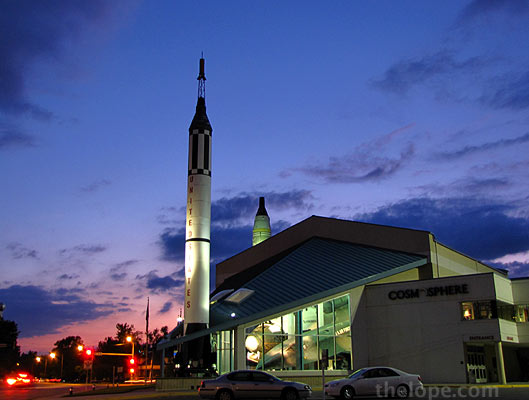
After doing a video clip of Chaikin for the Cosmosphere, I dallied awhile at the museum Saturday morning and watched rain drip off the fins of a Mercury-Redstone rocket. I feel rather lucky that I - a guy who was raised with the space program - can move among such relics so often.


I saw a clock run backward in the Fox Theatre during a showing of The Curious Case of Benjamin Button.


Early Sunday morning Spring gave way to Summer. I saw the first dragon fly of the season in my garden. It eats mosquitoes - if dragon flies could read, I'd hang a "welcome" sign.


We had one of those ten-minute storms Sunday evening. Here it is after it moved on.


Two sounds of summer emerged Sunday. The time had come for the ice cream truck to make its rounds in my neighborhood. Scott Joplin's "The Entertainer" has been replaced with "Happy and you know it" complete with cartoon sound effects and a "Hello" that could veer me toward a healthier diet. But not just yet - I bought an ice cream sandwich.

In the background you can hear what I was really excited about - the first sounds of cicadas in Hutchinson, Kansas.

Monday was the first full day of Summer and Spring yielded much in the manner of a delicate rain-drenched flower stepping into a hair dryer. It was just shy of 100 degrees.


Monday evening I was able to get a clip of the sound made by the cicada that most typifies those heard in these parts - Tibicen pruinosa. The little guys - and the ones that sing are all males - had emerged after two or three years growing underground, had moulted and were out singing for females. Whether they get lucky or not, they keel over in a few weeks. I'll have more on cicadas, soon - all in good time.

Sunday, June 21, 2009

Summer Solstice 2009

Welcome to summer; try not to shiver too much on this unseasonable cold night in Kansas.


It wasn't Midsummer Day; it was May of 1993 when I last saw Stonehenge. Had it been taken at mid-summer sunrise, this photo would show the sun rising over the Heelstone (the lone one in the distance) framed just like this. And though the site is famed for its solstice alignments, I wouldn't want to be there amidst crowds of modern day pseudo-druids. I picture it as somewhat like a Black Friday sale crowd in robes.

The guards entertained us with accounts of other guests. One had brought an ironing board, his clothes and an iron. He believed he could plug the iron into the mystic energy and leave with crisply pressed shirts. Another had bent a coat-hanger into the shape on an ankh (Egyptian cross) in an attempt to levitate after seeing this done in a commercial for Time-Life books.


All I wanted were pictures and I got them. I was a happy camper, but I'd never carry around that much equipment these days on a vacation: three camera bodies (for different films), seven lenses and three tripods - most of my luggage was camera stuff. (above two photos by Patsy Terrell)


You know what I've realized over the years? Every sunrise is special, no matter where or when it is seen. If you want to veer away from being too sentimental about it, just think for a moment about how it'd be if we'd evolved to breath a chemical mixture that is opaque. No transparent atmosphere means no visible sunrise. This one is pre-dawn, actually, over the Boston Mountains of Arkansas earlier this month, seen from the Sky-Vu Lodge in Winslow.

The tops of those ridges are made of Pennsylvanian sandstone and shale. The valleys cut into Mississippian limestones. You can see fossils from this period, 354 to 290 million years ago, in one of our earlier posts, Winter Frog.


And just because you've been very good, here's a bonus sunrise, shot two days after the one above, in the same location.

A reporter recently asked me how I came to be in so many marvelous places. I was in the Boston Mountains because friends Carl and Kris from Kansas City include me on what has come to be called the Food Coma Caravan, a whirlwind weekend conquest of independently-owned restaurants and off-beat sites, usually with interesting lodging as a base. We even saw a black bear one night.

Access to Stonehenge? A teacher friend of mine signed off on a permit application to shoot photos for educational purposes. I was in England with two friends after we'd all got airline tickets during a fare war. My mom was supposed to go, but couldn't in the end.

What's the common factor here? Friends - they're neater than sunrises (although that bear was pretty cool).

Sunday, June 14, 2009

Happy Flag Day, 2009


Joplin, Missouri, about 1979. This was during a homecoming parade for Missouri Southern State College (now a university). The building is along a stretch of Main Street (west side) that used to be Route 66. See a nearby section of Joplin's Route 66 Main Street shot on Flag Day of 2007, here.

Monday, June 01, 2009

Where is Ace Jackalope? (episode 28)


Why did the jackalope cross the road? Because it's made of brick and really cool. Where is Ace Jackalope?

Hint: Ace wore a pin for a variation of this photo but we can't show it yet because it's a dead giveaway. But I will tell you the pin was bought at the Joliet Area Historical Museum and Route 66 Welcome Center in Illinois.

Friday, May 22, 2009

The Sherlock Holmes Museum


This is the 150th birthday of Sir Arthur Conan Doyle (1859 – 1930), the man who set the game afoot. I'm a fan of Conan Doyle's Victorian detective, so while in London in October of 2006, Ace Jackalope and I visited The Sherlock Holmes Museum. Join us as we undertake "The Advenure of 221b."


To make this pilgrimage, one emerges quite appropriately from the Baker Street Underground station. For those of you planning a London trip, this station is accessible via the Bakerloo, Jubilee, Hammersmith, City, Circle and Metropolitan lines.


There's no doubt you've "minded the gap" at the right station, as the Sherlock Holmes profile wall tiles confirm.


The first mystery we found was the juxtaposition of a No Smoking sign with a multitude of smoking detectives.


There was nudity afoot - and it's more than the feet - in this poster for a National Gallery exhibit. No mystery here - The British are more casual about this. Remember, we're the ones descended from Puritans.


Upon leaving the station by the Baker Street exit, one happens upon this statue of Sherlock Holmes lording over his old environs. He is portrayed in the country outfit and deer stalker cap that Conan Doyle never described him as wearing. Indeed it would have been a fashion faux pas to have worn such an outfit in the city, and Holmes was described as very fashion conscious. He comes by his attire honestly, as he was shown wearing a similar outfit (in proper country environment) by Sidney Paget, who illustrated the original stories as they appeared in The Strand magazine.


I particularly liked this silhouette, against the background of houses lining the west side of Baker Street. Look at all those chimney flues. But I must confess that all is not as it seems. This view contained an incongruous street light, so I Photoshopped it out. Here's the unaltered version. I've long been an advocate of portraying life the way it really looks - power lines, streetlights and all (even Ace is seldom "doctored") - so I thought I'd present this as a photo-illustration instead of a photograph.

The statue was sculpted by John Doubleday, was commissioned by the Sherlock Holmes Society of London and was sponsored in 1999 by Abbey National plc to commemorate its 150th anniversary. "Plc" is a British abbreviation for Public Limited Company; Abby National is a bank which was known in the 1930s as "The Abby Road Building Society" and carried similar names in later years. For simplicity, I'll refer to it as "Abby."

Here's the interesting part of the inscription: "221b Baker Street, the address of Sherlock Holmes, is at the original headquarters of Abby National plc".

Their claim is correct as far as it goes, however "221b Baker Street" only came into existence as a postal address as a result of a renumbering that occurred in 1930 - long after the Sherlock Holmes stories were written. In the Victorian era, Baker Street addresses only went into the 100s and this street was called Upper Baker Street. Some early Conan Doyle manuscripts do place Holmes on Upper Baker Street, a fact that fuels aficionado discussions as to what should be regarded as Holmes' residence. (I've listened in on arguments on this topic that make any sci-fi geek discussion of Star Trek continuity errors pale in comparison.)


Back in the 1930s, Abby found itself the default home of Sherlock Holmes when the postal renumbering resulted in their receipt of letters to the fictional detective from all over the world. To cope with this, Abby created the position "secretary to Sherlock Holmes." A bronze plaque later applied to the front of their building carries a picture of Holmes and Conan Doyle's narrative detailing Holmes and Watson moving in at 221b. (I've seen the "b" as both upper and lower case in nearly all modern references to the address.)


While Abby was still receiving mail for Sherlock Holmes, the much newer Sherlock Holmes Museum applied through British bureaucratic channels in 1994 for permission to renumber itself "221b", but was denied. There was still a way to carry a "221b" sign however, and the museum utilized it.


By registering a company as "221b", the museum was able to display the number and letter combo on the door, despite it not being the official address. Abby moved out of the neighborhood in 2002 and the museum was able to lay claim to any mail addressed to "Sherlock Holmes" and lists its postal address as 221b Baker Street.

This reminds me of the American Movie "Miracle on 34th Street." I suppose if Santa lives in a retirement home on Great Neck, Long Island, than Sherlock Homes lived at The Abby Building Society and later, The Sherlock Holmes Museum.


There are surprisingly few other exploitative businesses in the area. This one, the Sherlock Holmes Memorabilia Company, was for sale in October of 2006.


The museum tries for a certain degree of period atmosphere before you even get in the door. Here's a larger version of a police notice about a murder in the area.


I just checked and the admission cost has not risen since my 2006 visit.


Inside, period accessories are all about.


An actor identifying himself as Doctor Watson welcomes us to the sitting room.

The museum tries for a resemblance to 221b as described in the first Sherlock Holmes story, A Study In Scarlet (1887). Holmes and Watson had first met in a pub and discovered they were both seeking lodging; Watson knew of 221b. "We met next day as he had arranged, and inspected the rooms at No. 221B, Baker Street, of which he had spoken at our meeting. They consisted of a couple of comfortable bed-rooms and a single large airy sitting-room, cheerfully furnished, and illuminated by two broad windows."


The pipe Holmes is usually portrayed as using is of the calabash design, so named because its makers originally used clabash gourds.


Along with Holmes' violin, the tools of a Victorian detective await a case.


There is even a photograph of "The Woman" - Irene Adler, who out-witted Holmes in "A Scandal in Bohemia," and for whom Holmes felt the closest thing to romance he was ever portrayed as displaying.


I was most impressed with this particular touch. In "The Musgrave Ritual", it is revealed that Holmes decorated the wall of the sitting room with a patriotic "V.R." (Victoria Regina) done in bullets. I don't imagine he would have made the best neighbor.

Exhibits must be changed once in awhile. In a visit back in the early 1990s, I remember a pattern of match sticks arranged in the code from "The Adventure of the Dancing Men" but our Doctor Watson could not find this for us.


Not all in this place is fictional recreation. The museum is an a real 1815 house complete with fixtures and for the American tourist, that alone is worth seeing.


Bedrooms of Holmes, Watson and their land lady, Mrs Hudson, display accouterments of period.


Doctor Watson's medical bag rests in the chair to this desk.


Obviously, Holmes would not have had Sherlock Holmes memorabilia, but it seems to work for the mood, anyway.


I was quite surprised by the cheery porcelain in the water closet.


The attic held travel gear.


Also in one of the upper rooms was a display of mannequins illustrating some of Holmes' and Watson's adventures.


"The Red-Headed League"


Professor Moriarty.


Yes, that's man dressed as a woman.


There is also a set of exhibits based on what objects from the published stories. This one is from "The Adventure of Wisteria Lodge." The label reads: "Voodoo fetish from the house of Mr Garcia found murdered in Oxshott common".


This bulldog revolver concealed in a bible is from "The Solitary Cyclist."


At top is a South American bird arrow and quiver from "The Sussex Vampire." At center are Andeman Islands poison blow-pipe darts and case from "The Sign of the Four." Below is a horn-handled clasp knife used in the murder of Pietro Venucci from "The Six Napoleons."


Of course there's a gift shop. That would be elementary. By the way, just as "Play it again, Sam" is never heard in the movie, Casablanca, "Elementary, my dear Watson", does not appear in any of Conan-Doyle's Sherlock Holmes stories.

The job openings at the museum are interesting to read. They sound pretty cool for a people with theatrical tendencies.


Ace, always on the look out for spare outfits, coveted these gift shop bears in deer stalker caps and hounds tooth pattern capes. Mysteriously, one of them was later found naked in the donation box of a thrift store. Curiously, Ace was not interested in taking the case and soon fled the country for the U.S.

Here is the Sherlock Holmes Museum website. There are other Sherlock Holmes sites in London, such as the Sherlock Holmes pub, which contains a replica of his quarters. Sir Arthur Conan Doyle's Sherlock Holmes stories are old enough to be public domain in most of the world. See the British website, Classic Literature Library.

Monday, May 18, 2009

Muffler Man


During a trip to Texas early this month I ran across a nice large bite of staple food for the roadside aficionado - a recently placed "muffler man."

These giants of the road were originally manufactured from the early 1960s to the middle 1970's as roadside attention getters by the International Fiberglass Company. There were several variations of which the cowboy was not uncommon. The name "muffler man" derives from the fact that some held mufflers for muffler shops, although they also held many other giant product representations.

This particular cowboy has watched Interstate 35 in Wynnwood, Oklahoma for about a year and half from his residence at Steppin' Out western wear in Wynnwood, Oklahoma at I-35 and hwy 29.


Steppin' Out owner Harold Marcum says he bought the cowboy from an individual who leased it to the film company that produced the movie, Twister. Marcum says the cowboy (approx 22 ft) was placed in a pond at Garvin County Lake for a scene in the film that was not used in the final production.

We'll be featuring more muffler men and other giants of the road as the year progresses.

Thursday, May 07, 2009

Star Trek Lives (again)

(no spoilers)

I saw the movie tonight. J.J. Abrams has succeeded in reviving Star Trek, which has been on an ever-increasing morphine drip since the beginning of "Voyager." Don't worry about canon; it all works.

Friday, May 01, 2009

The Devil Walks with Earthly Feet


It is Walpurgis Night - halfway around the sun from Halloween, yet more feared by Germanic people of old. Read about its place in Bram Stoker's Dracula as well as the work of J. K. Rowling in 2007's Nosferatu to Primavera and 2008's Walpurgis Night. And until dawn Walpurgis shares the clock with May Day, when the later takes over. Whether you chose to revel in darkness or light, may your way be safe.

(publication delayed due to server glitch)

Saturday, April 25, 2009

Train Rides this Weekend from Wichita to Yoder and Hutchinson

If you've ever looked at the railroad track at the side of Kansas highway 96 between Hutchinson and Wichita and wondered what it would be like to ride that train, here's a rare chance.

The Hutchinson Fiesta Train will run from Wichita to Hutchinson and back tomorrow, stopping near the Anchor Inn at noon where lunch will be served to ticket holders. Tickets are $50, cash or check (no credit cards), and can be bought at the loading site for the train at Walker and Osage streets in Wichita. I'm told they have tickets left.

The train leaves Wichita at 9AM and passengers are instructed to be on board no later than 8:50AM. If you need to buy a ticket, you should obviously get there earlier. The train is scheduled to leave Hutchinson at 2PM and arrive back in Wichita at 5PM.


A similar excursion, The Yoder Heritage Train, is running today from Wichita to Yoder and back, where lunch is currently being consumed at Carriage Crossing. There's a wireless signal here, so I'm able to send this.


Phil Aylward, car host, pauses as the train pulls into position to load in Wichita this morning.


This is former Missouri Pacific track, as Ace's eagle pin shows.

Both excursions are offered by WATCO inc., the Kansas & Oklahoma railroad, and the Heart of the Heartlands Railroad Club.

Friday, April 17, 2009

Wenches and Pie

Two fine and delightfully different entertainment options await Hutchinson/Wichita area Kansans this weekend.


The Spring 2009 Great Plains Renaissance Festival is this Saturday and Sunday in Wichita's Sedgwick County Park. The event's website says that the reproduction Viking ship above (behind the women) will be offered for boat rides. That's new this year as the ship is usually displayed land.


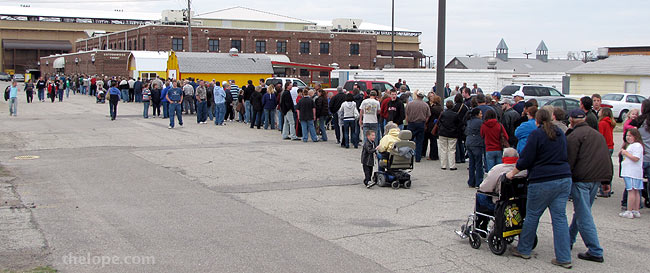
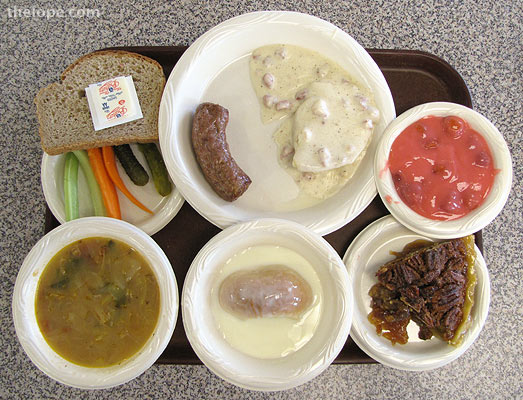
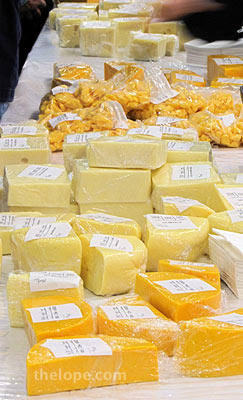
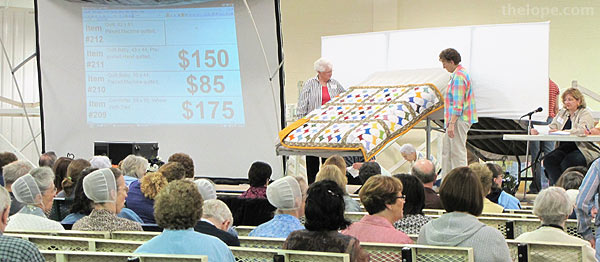
At the other end of more than one spectrum lies the MCC sale at the Kansas State Fairgrounds in Hutchinson today and Saturday, a rather large and diverse charity event held by the Mennonite Central Committee. There's more food there than one could ever want, quilts both traditional and no so much so, antiques (including big ones on wheels) and arts and crafts.


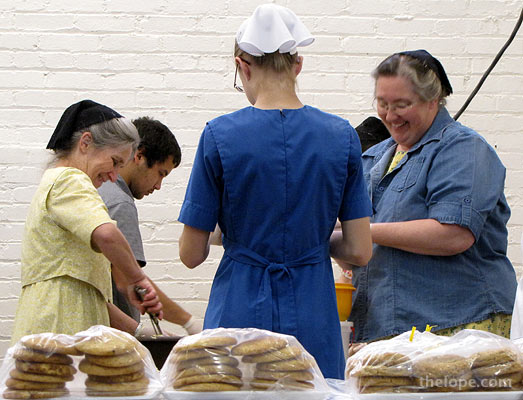
If you've never been, you gotta go just for the atmosphere...and the verenika...and the new year's cookies (above).

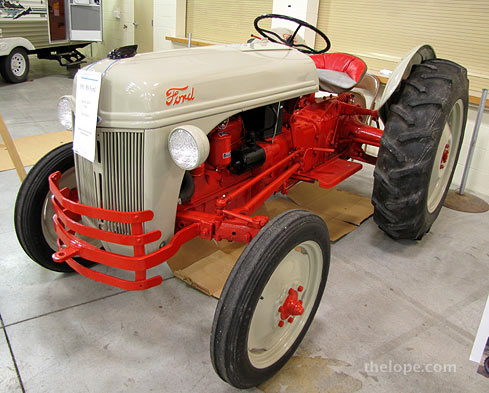
Even if you're not a farm type, you might want to check it out. Last year, they auctioned two tractors, including a Canadian Cockshutt designed by Raymond Loewy, who also designed the Coke bottle and put the finishing touches on boomerang formica. I've also seen vintage model train stuff there.

Please be aware that the MCC sale is largely over by the middle of Saturday afternoon so do check their schedule if you want to go.

See extensive photos of the MCC sale in 2007 and 2006. Their website is here. When you look at their site, do check out the fine print at the bottom of the front page - the stuff about the site itself. Whoever wrote it had a nice sense of humor.

Our photos from the Great Plains Renaissance Festival in previous years: Fall of 2007, Spring of 2007, Spring of 2006 and Fall of 2005. Photos of the festival also found their way into our Talk Like a Pirate Day posts in 2008, 2007, 2006 and our 2008 St Pats post.

Thursday, April 16, 2009

Arlo Guthrie at the Orpheum in Wichita


Folk legend Arlo Guthrie entertained a packed house at the Orpheum Theatre in Wichita, Kansas, last night.


The Orpheum is a 1922 theatre which is slowly undergoing restoration under the non-profit Orpheum Performing Arts Centre, Ltd., which owns it.

The theatre is located on Broadway, which is Wichita's stretch of old highway 81. Highway 81 from Park City, north of Wichita, through Haysville to the south, contains some nice examples of 20th century architecture that I hope to explore in more detail. The Chapel of the Sorrowful Mother is part of the Via Christi St Francis campus which is bordered on the west by Broadway just a few blocks to the north.


According to the theatre's website, The Orpheum is one of the best remaining examples of the "atmospheric" school of theatre architecture. This approach to theatre architecture emphasized decor intended to give the patron a feeling of being in a landscaped outdoor area. In the case of the Orpheum, architect John Eberson had in mind a Spanish courtyard.

The concert was a sell-out, by the way. I shot this before the show because house lights were still on, dim though they are.


Note Eberson's mock tile roofs over suggestions of building facades at the edge of the balcony. The starry night ceiling is also a neat feature.


The Orpheum is seldom open for tours but one will be offered May 3rd in conjunction with a car show on Broadway. Check out the theatre's website for details.


Back to the show at hand: With the 40th anniversary of the Woodstock festival coming up this August 15-18, I imagine we'll be seeing more media attention to Guthrie, who performed "Coming into Los Angeles" last night, a song he did at Woodstock.


Guitar enthusiasts have urged that I identify the guitars being played in photos. Based on an interview Modern Guitars Magazine conducted with Guthrie, I believe this is what he called a "GM-38 what they call a 'Quadruple O' Martin." closer photo


And this would be the a Gibson J-200 Vine. similar photos here and here.


What this pretty blue guitar is, I do not know.


I just know he sounded good playing it. Similar photos are here, here, here, here, here, here, here and here.


I'm not as familiar with his catalog as I'd like to be, but here are songs from the set list that I can identify: "Chilling of the Evening", "The Old Apple Tree", "Darkest Hour", "St. James Infirmary", "Cornbread, Peas, and Molasses", "Motorcycle Song", "Haleiwa Farewell", "Coming Into Los Angeles", "Pretty Boy Floyd", "Alabama Bound", "When a Soldier Makes it Home", "In Times Like These", "Days are Short", "City of New Orleans", "This Land" and "My Peace". "This Land", a song written by his father, Woody Guthrie, was done as a sing along. "Alice's Restaurant" was not performed, but the movie had shown at the Orpheum the previous night.


He also told stories about his father, Woody Guthrie, and friends such as Hoyt Axton. As a matter of fact, his style is a fluid storytelling/singing act. He obviously has a fan base with a devoted core; several of the people seated around me had followed the tour through more than the Wichita stop.


Guthrie took to the piano (A Yamaha) for several tunes, including my favorite, "City of New Orleans".


Guthrie's son, Abe, plays keyboards on this tour. The backup singers were the Burns Sisters.


Guthrie's own people seem genuinely amused by his stories. Considering how often they must have heard them, that's saying something.


Ace came prepared in a railroad engineer outfit ("City of New Orleans", you know) but we were not able to get a photo of Ace with Arlo. Ace's pal (and Arlo fan) Sharon did manage to pose with Ace and Abe Guthrie. Arlo Guthrie's tour schedule is posted on his website and lists dates over a year from now.

Sunday, April 12, 2009

Hidden Chapel


Happy Easter, 2009. I've been saving this. Just pretend you found it in your Easter basket.

During my friend Patsy's recent stay at Via Christi hospital's St Francis Campus in Wichita, Kansas, a late-night walk led me to a chapel of unconventional beauty.


Now, to preface this I should set the scene. Via Christi is a fine hospital in my experience. The building suits its purpose well and the atmosphere and quality of service actually reminded me of an upscale hotel (with the added service of slicing your friend open and removing bad things). It's a fine building with some interesting views and some older parts visible on the outside, yes - but hardly riveting in any respect.

So, with Patsy asleep, I went to see what the hospital chapel looked like. I'm not sure why, even to this day. Maybe three weeks of wondering if my best friend had cancer, followed by the relief that she probably did not, made me want to go somewhere solemn.


Human Resources - Main Lobby - Public Restroom - The Chapel of the Sorrowful Mother. I still find something funny about the grouping of such a distinctive name with such generic ones. And I'm not Catholic and am pretty sure my mom is happy, but, man, that is one guilt-inducing name.


The sign doesn't do the place justice. The change from institutional sterility to age and character is sudden and jarring. And I swear there must be a distinct audio signature for footsteps in a church or school hallway. Maybe it was the sense of trespassing that comes with wandering abandoned corridors, but I felt rather as if I were reporting to the principal's office.


Just inside the corridor is a pieta-like sculpture. I actually felt like I was intruding on a moment of grief - like my gaze should not linger. On the windows to the left you'll see what looks like a mid-century modern graphic, possibly of grapes and a cross - my first clue I was in for a stylistic treat.


Stained glass windows with a Kansan feel line the corridor. I assume the yellow stalks to be wheat. The grapes are obvious, but I don't know if the flower is intended as a sunflower or any specific type. This gave a hint of the stained glass inside - stay tuned for that.


An elevator door of a green usually found in the memories of grade school hallways bears the warning, SISTERS ONLY.


Of course, respect and that still-lingering sense of trespassing are one thing and curiosity, another. So I pushed the elevator button. I think the interior louvers smack of Art Deco.


The corridor ends at this door, guarded by two angels, lending a sense of solemnity. Another view


There is some glass and woodwork above the door.


But that's as far as I got the first night. I was left with this enticing view through the crack between locked doors.

I was quite excited. I had no idea there was room for anything of this apparent size and age in this modern hospital and had expected at the end of the corridor to find a room about the size of chapels I'd seen in other hospitals - rooms about the size of a corporate board room and modestly decorated. Looking through that crack was like a trick of depth perception and lent to a sort of Raiders of the Lost Ark feel.

I had assumed from outside views that Via Christi was a large cubic mass and not what it really is - a rectangle, the sides of which are joined buildings of various ages. This substantial church must lie hidden at the center.


Hidden, indeed. The Chapel of the Sorrowful Mother has been totally surrounded by the growth of Via Christi and its predecessor, St Francis hospital, for which it was built in 1947. You can see the connecting corridor at lower left.


It is an odd thing to look down on a steeple.


The best view I found of the front of the chapel was afforded through the clearer parts of a decorative window, looking south from a waiting area of the Harry Hynes hospice on the 8th floor of Via Christi. I also like this semi-prismatic view.


This is a view looking north from a window in Via Christi. The architects, by the way, were Maguolo and Quick of St Louis.


And here is a night view, looking west with Broadway (highway 81) beyond the hospital. This was shot from a stairwell window.


An exhibit in one of the hospital corridors shows a photograph of the chapel when it was surrounded on only three sides.


The day after I was stopped by locked doors, I managed to make it there during open hours. The chapel was empty as it almost always was in subsequent visits.

Note the use of coffers - those sunken ceiling panels - to reduce weight. The same technique was employed by the builders of the Pantheon in Rome.


One can easily forget one is in a hospital, and the generic sign outside seems ludicrously inadequate as an indicator of what's in here.


At the front is a domed mosaic. A hospital display states that it was paid for by employee donations.


There's the statuary you'd expect in such an ornate place. That's Mary and St John with Christ.


I was puzzled by this statue of St. Francis of Assisi with a skull at his feet.


Sister Sherri Marie Kuhn of Via Christi tells me the skull represents death, which he embraced as a sister. She advises reading St. Francis' poem, "Canticle of the Sun" to understand this in context.

There is also a votive candle area, but I found its statuary to be less remarkable than the other art in the chapel. photo photo photo


There are mosaics of the stations of the cross. This is the sixth station, "Veronica wipes the face of Jesus." I'm not Catholic and am unfamiliar with stations of the cross so I did a little reading. Apparently legend has it that while Christ was carrying his cross, a woman named Veronica (some sources state the name means "true image"), moved with pity, used her veil to wipe the sweat and blood from his face. As the mosaic suggests, his image was left on the veil. I don't know the age of this legend but it might have interesting ties to the belief that there is an image of Christ out there somewhere, as in the Shroud of Turin.

I was not able to find out the name(s) of the artist(s) who did these, or the domed mosaic. If anyone can provide a source on this, please comment.


It was the stained glass windows that I found most intriguing. They have echoes of both Art Deco and Art Nouveau, though both styles were past their prime in 1947. Sister Sherri Marie Kuhn believes this one to be either Mary, Queen of Prophets or Mary, Queen of Patriarchs.


All of the stained glass windows in the chapel, including those in the connecting hallway, were made by the Emil Frei Company of St Louis, a 111 year-old family company that is still in business using very old techniques. They made the "space window", which actually contains a sliver of moon rock from Apollo 11, for the Washington National Cathedral. Ironically, the Emil Frei website was blocked by Via Cristi's Internet filters when I was there in late January. I do not know why as there is nothing remotely objectionable on the site, though it is incomplete.

I phoned the company and spoke with its president Stephen Frei, 55, the great-grandson of founder Emil Frei. He did not know anything about the Chapel of the Sorrowful Mother as it was before his time and he had no detailed records of it, but it was a fascinating conversation about the what he called the "15th century cottage company."

"We're part of a dying breed" he said. He mentioned that Emil Frei company also did windows for other Wichita area churches including Saint Ann's and Church of the Resurrection.

On a tangent too interesting not to mention, Stephen Frei mentioned that not all members of the family went into the stained glass business. There was one black sheep, he joked, and told me of his relative, Emil Frie III, a pioneer in Chemotherapy who developed the first treatment that led to a complete cure for childhood leukemia.


Linda Landoll of Via Christi furnished me with explanations of the tiers of individual images from her copy of a brochure that is no longer distributed at the chapel:

"Windows on the east side of the Chapel:
The first row represents the Symbols of the Joyful Mysteries.
The second tier is the Symbols of the Litany of the Blessed Virgin Mary.
The third tier addresses the Virgin in her role as Queen of Heaven and Earth.
The bottom tier is the Ave Maria or Hail Mary.

The windows on the right (west) are the Epistle side and go from the front of the Chapel toward the back.
The first row symbolizes the aspects of Catholic teachings.
The second tier is Outstanding Saints of the Church.
The third tier is the Sacraments.
The fourth tier: primeval history, how God created heaven and earth
"


Going from this information, I believe this panel in the primeval history series might have to do with the creation of the world.


In the same row, I assume these are the fish of the sea.


Also in the primeval series, this panel looks particularly Kansan. It's funny how any sufficiently abstract graphic works like a Rorschach test. I look at the part at lower left and see barbed wire fences. I doubt that was the intent. They are growing crops, perhaps?


This panel would be "mankind."


In what I would later learn is the "Outstanding Saints of the Church" tier are four images, a man, a horned animal, a lion and a bird - all wearing what looks like armor - that particularly intrigued me. The lion, calf/ox/bull, man and eagle quartet shows up a few times in the Bible and ancient theologians seemed intent on assigning the four animal identities to the writers of the four gospels.


Before I knew they were supposed to be saints, I called on what little I know of the Bible and remembered a bit of Revelations (4:7-8 - Yes, of course I had to look it up): "The first creature was like a lion, and the second creature like a calf, and the third creature had a face like that of a man, and the fourth creature was like a flying eagle."


Pretty scary-cool, that, but it's not what the figures represent. Same image but shot when there was rain on the outside of the glass


Since they are saints (the halos would be a dead give-away even without the brochure information), the man is Matthew, Mark is the lion, the ox is Luke and John is the eagle. I should note that in my limited reading on this, that the exact assignment of symbolic animal to apostle varied with different theologians, though those listed above seem the most accepted. Corrections are invited.


The circular stained glass window above the loft reads "Ave Maria Gratia Plena", which translates as "Hail Mary, full of Grace."


Sister Janice of Via Christi took us up into the loft using that "sisters only" elevator.


The loft was added sometime after original construction and partially obscures bits of two windows.


But it does afford a good view.


Here's a close-up view of those coffers, along with the organ pipes.


Outside the entrance hallway to the chapel is a small museum, though its information about the chapel is minimal. It does have a stained glass of the order's founder, Mother Francis Streitel and replicates her quarters. it is open only on Thursdays for limited hours.


Right before Patsy's release from Via Christi and the end of my time there as a visitor, I found a way out onto the grounds around the chapel using a door in a glass hospital corridor. That door would not let me back in and I found a long way around, though I'm not sure that's the norm.


It is an odd thing, seeing the older reflected in the newer.


The rectangular projection at right is the confessional.


Rose bushes awaited the Spring with a statue of Mary in the background.


A statue of St Francis carries a message.

Other exterior views are here, here, here and here. As I left the courtyard, a set of garden gnomes seemed to look on.

The closest entrance to the chapel is at the northeast corner of Via Christi on the east side. Parking is limited and dedicated to patients for specific purposes, so you might want to use the parking garage and walk, or simply go through any hospital entrance.

Saturday, April 11, 2009

The Church of the Neon Cross


I was quite delighted when I saw the blue neon cross above nocturnal Route 66 near Hamel, Illinois. Having just left the St Louis area bound for the 2008 Route 66 Festival in Litchfield, Illinois, I had hoped for something of interest in the dead of night. The mother road did not disappoint.


It's not really called the "church of the neon cross", of course. This is St. Paul Lutheran Church, a 77-year-old church building that serves a congregation begun 153 years ago.

I emailed Rev. William Weedon of the church and he told me the cross was given in about 1946 in memory of Oscar Brunnworth who died in action in World War II. He believes Mr. Brunnworth died in Italy.

I'm seeing more and more neon crosses these last couple years. They are usually confined to signage and their consistent appearance - tall, thin, white - suggests they are mass-produced add-ons.

What impresses me most about the St. Paul cross is that it looks like it belongs there - like the original architect would have approved. Kudos to the church powers-that-be who decided over 60 years ago to allow something different, and what an enduring way to remember the sacrifice of Oscar Brunnworth.

Friday, April 10, 2009

Shadow Cross


Happy Good Friday to you all. I shot this in about 1980 along 15th Street in Joplin, Missouri. A google street view shows the front of the building - the Friendship Baptist Church - has changed drastically. The front doors are different, the window has been filled in, the porch railings replaced and an awning added. Most of all though, the cross sign has been removed so there's nothing to cast a shadow.

I regret that I did not shoot a separate photo of the sign; I think it may have been neon. I imagine such things seemed more commonplace to me then, as indeed they were.

Thursday, April 09, 2009

Easter Egg Tree


This is a sight I hope to see become more common - the Easter egg tree.


There's just something very "harbinger of Spring" about seeing dots of pastel colors hanging in bare trees.


I don't even mind that these are mass-produced plastic eggs made in China.


I saw these in Joplin, Missouri last month. Joplin has milder winds than does Hutchinson, Kansas. I don't think they'd work as well here.


Now...what would they look like with lights in them?

Wednesday, April 08, 2009

Texas Bunnies


I don't know if their ribbons were Easter-wear, but these bunnies looked out from the porch of a house along Texas highway 287 in Clarendon, TX, back in February.

Tuesday, April 07, 2009

Easters Past

Easter is an intriguing brew of the pagan, the Christian and the commercial. Of course, I do my part, and here are a few past contributions.


I got the idea when I saw hundreds of peeps lined up in packages on a shelf at Target and they reminded me of the buried terra cotta soldiers of the Qin Dynasty. But only Ace knew what to do with that confectionery army in Lope of the Peeps.


It's just the one shot, but we haven't let Ace decorate Easter eggs since the Egg Mishap.


It was called Rapa Nui, but that didn't stop the crew of the Dutch ship that "discovered" it on Easter day in 1722 from naming it Easter island. Since then, the intriguing giant heads - moai - have colonized pop culture. See more in Happy Easter Island.


From Route 66 in Texas to London, UK, to Chapman, KS, see images of Christ on the cross in Good Friday. I didn't know until I worked on that post that it's only a crucifix if Christ is portrayed on the cross; otherwise, it's just a cross.


See a real Easter Island moai as well as pop-cultured ones in London, Tucson, Portland and Seattle in More Easter Stuff.


On a rainy night a huge cross in Texas cast its shadow on the clouds. See it, and some beautiful rural New Mexico cemetery art in Risen.


Take a walk through the mini-golf ruins of Kentucky's Golgotha Fun Park. Yeah, that's really the name.


It's mostly a recap post like this one, but see a 17th century crucifix at the Phoenix Art Museum in Happy Easter 2008.

I'll have brand new Easter stuff everyday until Sunday, so stay tuned.

Monday, April 06, 2009

To Touch the Moon

If you'd told me when I was ten years old that I'd someday be able to touch a moon rock, I'd have said "of course, because we'll all be able to go to the moonbase by 2000." I seem to be off by a few years.


And I did touch a moon rock Sunday. You can too if you come to the NASA Driven to Explore mobile exhibit parked by the main doors of the Kansas Cosmosphere and Space Center in Hutchinson on Monday, April 6, 2009 from 9AM to 5PM. Admission is free.


The exhibit trailer is essentially an information/PR exhibit for NASA's planned return to the moon. It has been in Hutchinson since Saturday.


The moon rock (atop the base to the left) is the star of the show - and it should be - given that it is one of only seven pieces available for the public to touch. It has seniority over most rocks on the surface of the Earth in that it is 3.75 billion years old. It is very securely fastened down and is protected from the top by the pictured plexiglass shield. You can slip your fingers in under the shield and touch the sample, which is cleaned daily.


What your fingers will touch is a small sliver (.7 oz) of 16.75 pound "lunar sample 70215,11" made of mare basalt. It was picked up by Astronaut Jack Schmitt during the Apollo 17 mission in 1972 - the last manned moon mission.

Or rather I should say, Apollo 17 was the most recent manned moon mission as NASA does not intend for it to be the last. Exhibits in the trailer detail just how NASA plans for us to go back.


The model on the left represents the proposed Ares 1 rocket, which is designed to carry astronauts into Earth orbit in the Orion spacecraft, a descendant of the Apollo command module. The Orion would be configured to carry six astronauts to the space station or four on a lunar mission. Its thrust system combines the solid fuel technology of the space shuttle with a liquid fuel rocket.

NASA plans call for the Orion to rendezvous with spacecraft carried into orbit by the much larger Ares V rocket (right). The Ares V would carry an Earth departure stage and the proposed Altair lunar descent module.

Thus, instead of launching an all-in-one moon mission in one rocket as done with the Apollo program, NASA plans to send up larger components and more astronauts in two separate vehicles, which will then assemble for the trip to the moon while in Earth orbit.


Both craft are under the umbrella of NASA's Constellation program. Check out the cool retro logo, by the way.


As an aside for aficionados of the retro-space look, take in the NASA logo on the end of the trailer. The logo, nicknamed "the meatball" dates from 1959 and was used until 1975, when an unfortunate decision replaced it with a less-dated - but very mundane - logo. The classic meatball logo was brought back in 1992 by administrator Dan Goldin as a way of reminding the public of the glory days of NASA. PR move or not, I'm glad it's back.


As you leave the exhibit, an employee will likely offer to use a small cam to put your face in a a picture of a space suit helmet against your choice of several backgrounds. Ace chose the retro lunar module which looks like an artist's conception of the Altair.

The picture is free, by the way, and they don't even ask for an email address with which to spam you. Also, there was a box of free plastic NASA visors just inside the door of the Cosmosphere.

So, that's a free picture, a free visor, an educational exhibit and you get to touch a moon rock. Not bad; not bad at all.

July 20 of 2009 will mark the 40th anniversary of the first manned moon landing in 1969. The Cosmosphere has a number of artifacts of that mission - Apollo 11 - including a moon rock, though you cannot touch it. See some of the Cosmosphere's Apollo 11 exhibits in a story we did in 2007 called Walking in Distant Footprints.

Doggone Easter Egg Hunt


Doggies went nose to shell with treat-filled plastic eggs at the Doggone Easter Egg Hunt, a fundraiser held this past Saturday by Cause for Paws, a Hutchinson Kansas organization that's mission includes supporting the Hutchinson Animal Shelter. Another picture


Sniffing the ground is Queen Maile, ordained so by Mayor Trish Rose. Maile's human is Pam Paulsen (pictured), who also owns a cat named Mokihana, and thereby hangs a Polynesian tale.

Pam used to live in Hawaii on the island of Kauai. Maile is a fragrant vine used in leis. Mokihana is the name of a Hawaiian tree, the anise scented fruit of which is also used in Leis on Kauai. Cool, huh?


Maile was crowned, along with a king doggie, after an Easter parade Saturday at the new Hutchinson Dog Park on South Severance near the Hutchinson Animal Shelter.


It was a windy day, which made for interesting doggy pictures.


Humans got blown around a bit, too.


The dog park is a pair of large fenced areas with a bit of landscaping for variety. I imagine this place is a godsend for people with dogs and no yards.


For a donation, the Easter Bunny would pose with your dog.


Inside the Hutchinson Animal Shelter, there was a kitty condo decorating contest. People could vote by dropping quarters into the accompanying cups. Julia Ellis won with this entry.


But the real kitty condos of the animal shelter are these extensive interconnected but separable chambers that hold cats waiting for a home. The whole place is impressively clean and lends to its role as adoption facility that works hard to place healthy cats and dogs.


These are the eyes of Portabello, a striking beautiful four year-old black domestic short-hair cat - wormed and vaccinated.


The animal shelters works with cats to see that they are socialized. Here, Hazel holds Portabello.


This is Eric, six months old - also vaccinated and wormed.


Eric is very playful kitty, and even tried to play with me from within his chamber.


"I can haz home?"